The timeline
History, with its sources attached
This is the record in order, from the ancient ports of Gaza to the courtrooms of The Hague. Nothing here is unsourced. Where a claim is contested, we say so and link the evidence both ways.
Before 1917
An ancient land
Canaanite farmers worked this land thousands of years ago. Empires came and went, from Assyria to Rome, and then the Ottomans held Palestine for four hundred years.
-
c. 3300 BCE
The first city at Gaza
The oldest confirmed settlement at Gaza is Tell as-Sakan, an Egyptian fortress built south of the modern city to guard Egypt’s eastern frontier. Gaza has been inhabited ever since: it sits on the coastal road between Africa and Asia.
Sources -
c. 1150 BCE
The Philistines and the five-city coast
Egyptian inscriptions at Medinet Habu name the Peleset, linked by scholars to the Philistines, whose five city-states included Gaza, Ashkelon, Ashdod, Ekron, and Gath. The Book of Judges places Samson’s captivity in Gaza.
Sources -
730 to 332 BCE
Assyria, Babylon, and Persia
Assyria conquered the region in 730 BCE, Babylon took it over around 601 BCE, and Persia overran Gaza after a siege in the late sixth century. Herodotus called Gaza one of the greatest cities of the region.
Sources -
332 BCE
Alexander's siege
Alexander the Great was wounded storming Gaza’s walls, then killed its men and enslaved its women and children. After his death the Ptolemies and Seleucids fought over the city for a century.
Sources -
63 BCE
Rome
Pompey’s conquest brought Gaza into the Roman Empire, where it flourished as a Greek-influenced port town. Decades earlier, in 96 BCE, the Hasmonean king Alexander Jannaeus had stormed the city.
Sources -
4th to 6th centuries CE
Christian Gaza
Gaza became a centre of Christianity, and Bishop Porphyry won imperial backing to close its pagan temples around 401 CE. The empire reorganised Palestine into the provinces of Palestina Prima, Secunda, and Tertia. The church of Saint Porphyrius in Gaza City still carries his name.
Sources -
634 to 636 CE
The Islamic conquest
Muslim armies took Gaza in 634 CE, the first Palestinian city to fall, and the battle of Yarmouk in 636 fixed the conquest of the wider region. The area became Jund Filastin, the district of Palestine, under the caliphates.
Sources -
1099 to 1187
Crusaders and Saladin
Crusaders took Gaza early in the twelfth century, and Baldwin III built a castle there held by the Knights Templar. Saladin’s victory at Hattin in 1187 restored Muslim rule.
Sources -
1260
Mamluk Gaza
The Mamluk general Baibars broke the Mongol advance at Ain Jalut, near Gaza. The city then served as a Mamluk provincial capital until 1516.
Sources -
1516 to 1917
Four centuries of Ottoman rule
The Ottomans defeated the Mamluks and ruled Palestine for four hundred years, governing it from the provinces of Damascus and Beirut, with Jerusalem as a special district. Gaza lived through all of it as a port town on the caravan road to Egypt.
Sources
1881 to 1948
Migration, promises, Mandate
European Jewish migration begins. Britain promises the same land in different words to different people, then holds it under a League of Nations Mandate.
-
1881 to 1903
The First Aliyah
Fleeing pogroms in the Russian Empire, the first large waves of European Jewish migration reached Ottoman Palestine. By the end of the century Jews numbered perhaps 50,000, in a population of well over half a million.
Sources -
1904 to 1914
The Second Aliyah
A second wave of migration strengthened the Zionist movement’s institutions in Palestine during the last Ottoman decade.
Sources -
1915 to 1916
Britain's letters to Mecca
Britain corresponded with Sharif Hussein of Mecca about an Arab revolt against the Ottomans, and the letters promised postwar Arab independence. Whether Palestine was included in that promise has been disputed ever since. It was the first of the wartime promises.
Sources -
May 1916
Sykes-Picot
In secret, Britain and France divided the Ottoman Middle East between themselves, leaving Palestine’s fate to an international administration. The Bolsheviks published the agreement in 1917, to everyone’s embarrassment.
Sources -
2 November 1917
The Balfour Declaration
Britain declared support for “the establishment in Palestine of a national home for the Jewish people”. The people already living there were over 90 percent of the population and owned about 97 percent of the land. Nobody had asked them.
Sources -
December 1917
Britain takes Palestine
Allenby’s forces took Gaza in 1917 and entered Jerusalem that December, ending four centuries of Ottoman rule. British military government, then civil administration, began.
-
1922
The League of Nations Mandate
The Mandate charged Britain with securing “the establishment of the Jewish national home” and facilitating Jewish immigration, while requiring that no discrimination be made between the inhabitants and that their civil and religious rights be safeguarded. The population was about 750,000, three-quarters of them Muslim.
-
1929
Riots and rupture
Tensions over the Western Wall erupted into violence in Hebron, Safed, Jerusalem, and elsewhere. Scores died on both sides, and Gaza’s ancient Jewish community did not return.
Sources -
1936 to 1939
The Arab Revolt
Palestinians rose for independence in a general strike and armed revolt. Britain suppressed it with mass detentions, home demolitions, and collective punishment. The Peel Commission proposed partition in 1937; the idea did not die there.
Sources -
May 1939
The White Paper
Facing the revolt, Britain limited Jewish immigration to 75,000 over five years and restricted land purchases. It angered the Zionist movement and won no Arab support.
Sources -
1939 to 1945
The Second World War
Palestine stayed under British rule through the war. The Holocaust in Europe transformed the politics of Jewish migration to Palestine and pushed the Mandate toward its end.
Sources -
April 1947
The banner at Haifa port
The famous photograph of this period shows Jewish refugees aboard the detention ship Theodor Herzl at Haifa port, beneath a banner reading “The Germans destroyed our families and homes. Don’t you destroy our hopes.”
It is widely mislabelled as the Exodus. The ship was the Theodor Herzl, and the month was April 1947. The photograph is not public domain, so this archive tells the story and links the record instead of reproducing it.
-
July 1947
The Exodus 1947
A former US steamer bought by the Haganah left France on 11 July 1947 with over 4,500 Holocaust survivors bound for Palestine. British destroyers intercepted it, and three people were killed in the boarding on 18 July.
The British towed the ship to Haifa, above, moved the passengers to prison ships, and eventually deported them to camps in Germany. The episode drew worldwide sympathy and fed the pressure that produced partition within the year.
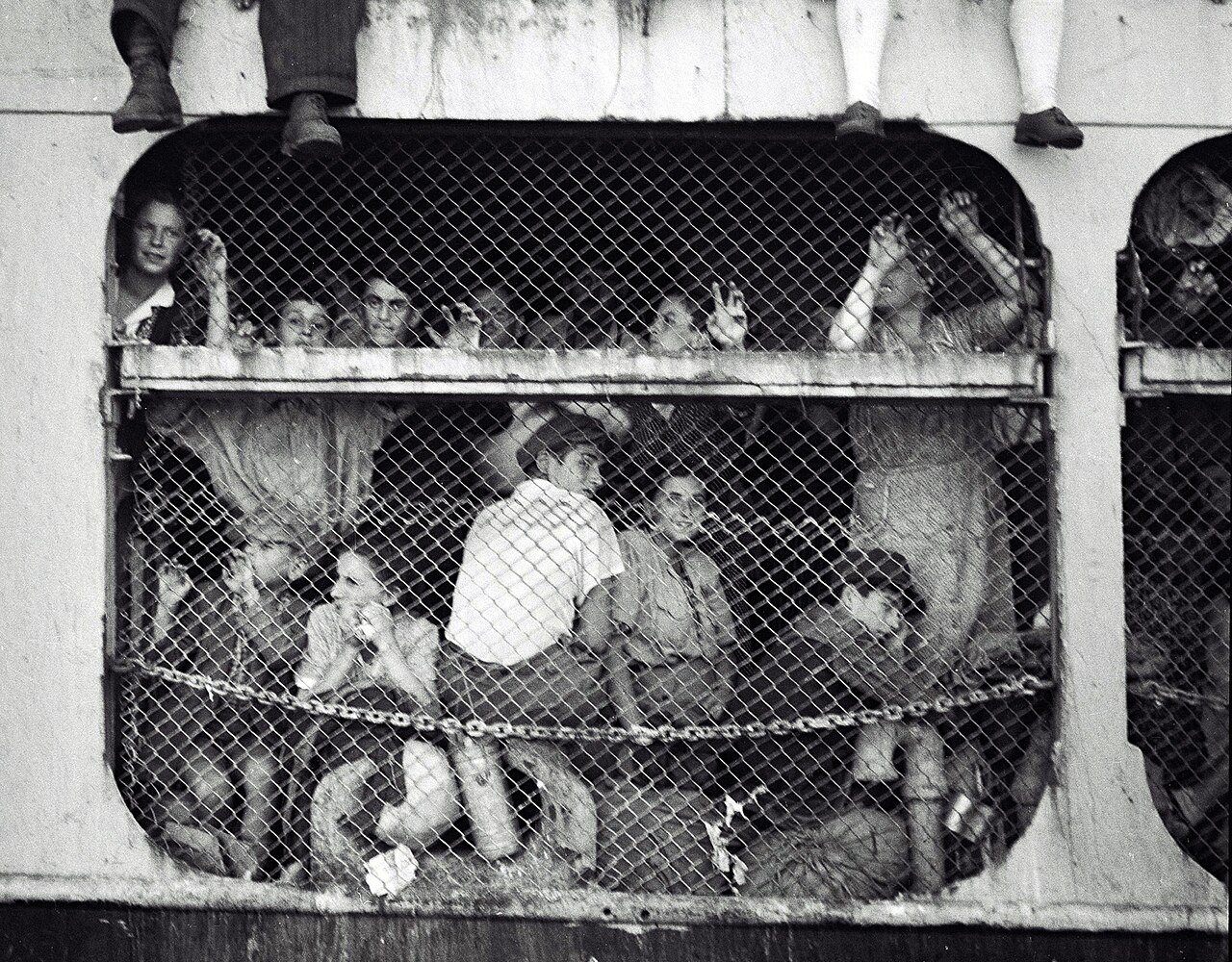
Photo: Hans Pinn, released to the public domain -
29 November 1947
UN Partition Resolution 181
The UN voted, 33 to 13 with 10 abstentions, to split Mandatory Palestine into a Jewish state with about 56 percent of the land, an Arab state with about 43 percent, and an international Jerusalem. Jews were about a third of the population and owned less than 7 percent of the land; inside the proposed Jewish state, Arabs were nearly as numerous as Jews.
Zionist leaders accepted the plan. Arab leaders rejected it. The map above is on the Maps page.
Sources
1947 to 1967
The Nakba and the wars
Partition led to war, and war to the displacement of most of Palestine's people. The armistice lines held for nineteen years. In June 1967, Israel occupied what remained.
-
30 November 1947 to May 1948
Civil war
Violence surged after the partition vote, with a general strike called by the Arab Higher Committee and paramilitary fighting as British forces prepared to leave. The Mandate ended on 15 May 1948, a day early.
Sources -
9 April 1948
Deir Yassin
Irgun and Stern Gang fighters attacked the village of Deir Yassin near Jerusalem and killed at least 107 Palestinians, most of them women, children, and the elderly.
News of the killings spread panic and mass flight through the villages around it. That was the point at which the catastrophe stopped being threat and became motion.
Sources -
14 May 1948
Israel declares independence
David Ben-Gurion proclaimed the State of Israel in Tel Aviv as the Mandate expired. The United States recognised the new state the same day.
-
1948 to 1949
The war and the Green Line
Arab states intervened, and the war ended with Israel holding territory well beyond the partition plan. Egypt held Gaza and Jordan held the West Bank including East Jerusalem. The armistice lines drawn in 1949 became known as the Green Line, and the armistice agreements said plainly that they were not borders.
Sources -
1948
The Nakba
Around 700,000 Palestinians fled or were driven out during the war: more than half the Palestinian population, in the UN’s own description. Israel ended the war holding about 78 percent of historic Palestine, and by Palestinian researchers’ counts more than 500 villages were emptied.
Gaza’s population swelled with refugees who were never allowed home. The keys are still kept.
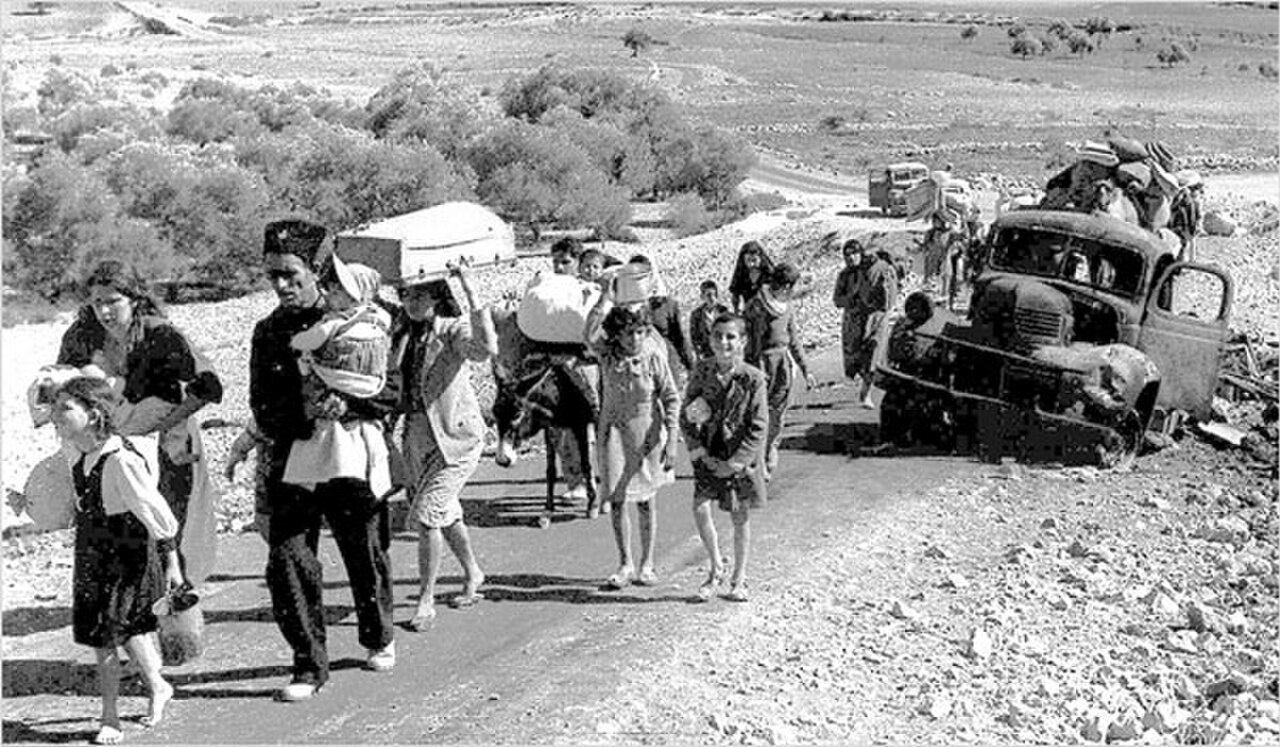
Photographer unknown, 1948 (public domain) -
11 December 1948
Resolution 194 and the right of return
The General Assembly resolved that refugees wishing to return to their homes and live at peace with their neighbours “should be permitted to do so at the earliest practicable date”, with compensation for the rest.
It has been reaffirmed almost every year since. The return has never been permitted.
Sources -
1949
Gaza under Egyptian administration
Egypt administered Gaza for the next nineteen years, briefly through the short-lived All-Palestine Protectorate. The Strip’s refugees were never offered Egyptian citizenship, and Gaza’s registered refugee population later grew to over a million.
Sources -
1956
Suez
Israel invaded Sinai and occupied Gaza during the Suez Crisis, then withdrew in 1957 under international pressure. It was a rehearsal for what came ten years later.
Sources -
5 to 10 June 1967
The June war and the Naksa
In six days of war Israel captured Gaza, the West Bank, and East Jerusalem, putting all of historic Palestine under its control. Palestinians call it the Naksa, the setback.
At first Israel’s “open borders” policy let Gazans work inside Israel. The occupation it began has never ended.
Sources
1967 to 2005
Occupation and resistance
Settlements spread, intifadas rise, Oslo promises and disappoints. Gaza's settlers leave in 2005 while its borders stay closed.
-
1967 onward
The settlements
Israel began settling its citizens in the occupied territories, including Gaza. The first post-1948 civilian settlement there opened in 1977; by 2005 there were 21, housing roughly 8,000 settlers.
Sources -
30 March 1976
Land Day
Israeli forces killed six unarmed Palestinian citizens of Israel during protests against the confiscation of Arab-owned land in the Galilee. The date became an annual day of commemoration, kept by Palestinians wherever they live.
Sources -
June to September 1982
The Lebanon war and Sabra and Shatila
Israel invaded Lebanon and forced the PLO’s evacuation from Beirut. On 16 to 18 September, Israel-allied Phalangist militias massacred Palestinian civilians in the Sabra and Shatila camps while Israeli forces controlled the perimeter. The Security Council condemned the “criminal massacre of Palestinian civilians in Beirut” in Resolution 521.
-
December 1987
The First Intifada
A mass uprising of boycotts, strikes, and stone-throwing began in Gaza and spread to the West Bank, met with mass arrests and force. It lasted into the early 1990s and produced a generation of organisers.
Sources -
December 1987
Hamas is founded
Sheikh Ahmad Yassin and other Muslim Brotherhood members founded Hamas, the Islamic Resistance Movement, in Gaza during the Intifada’s first months.
Sources -
1993 to 1995
The Oslo Accords
The 1993 Declaration of Principles and the 1995 Oslo II accord created the Palestinian Authority and split the West Bank into Areas A, B, and C: about 18 percent under full Palestinian control, about 22 percent shared, and over 60 percent, Area C, under full Israeli control.
It was meant as a five-year transition to statehood. The five years ended in 1999.
Sources -
1994
The Palestinian Authority
Yasser Arafat returned from 27 years of exile to head the new Palestinian Authority under the Oslo framework.
Sources -
2000 to 2005
The Second Intifada
The second uprising began in September 2000 and brought years of fighting, Israeli reoccupation of Palestinian cities, and the collapse of the peace process.
Sources -
2002 to 2004
The separation barrier
Israel began building the West Bank separation barrier. In its advisory opinion of 9 July 2004, the International Court of Justice found the wall and its associated regime unlawful, “tantamount to a de facto annexation”, and said it must be dismantled and compensation paid. The barrier still stands.
-
August to September 2005
The disengagement
Israel evacuated its soldiers and about 9,000 settlers from Gaza’s 21 settlements, while keeping control of Gaza’s borders, airspace, and territorial waters.
That retained control is the reason the United Nations continued to count Gaza as occupied, a position the International Court of Justice affirmed in 2024.
Sources
2006 to 2023
Gaza under blockade
Closure by land, air, and sea. Four wars in fifteen years, and the United Nations warning year after year that Gaza was becoming unliveable.
-
25 January 2006
The election Hamas won
Hamas won the Palestinian legislative elections, fair and by the ballot. The Quartet demanded it renounce violence and recognise Israel; sanctions followed instead of a government. The Palestinians had voted, and the result was not permitted to govern.
Sources -
June 2007
The blockade begins
After factional fighting that killed more than a hundred people, Hamas ousted Fatah’s forces from Gaza. Israel and Egypt sealed the Strip, with Israel tightening the closure from September 2007.
Before the closure, about 400 lorryloads of goods entered Gaza daily.
Sources -
2008 to 2012
The Red Lines document
Israeli officials calculated the calories and grams of food Gaza’s population would be permitted to consume; the policy’s emblem was a 2006 remark by the adviser Dov Weisglass about putting “the Palestinians on a diet, but not to make them die of hunger”.
After a three-and-a-half-year legal battle by the organisation Gisha, the “Red Lines” paper became public in October 2012. It showed Israel allowed 67 lorryloads of goods a day against the 106 its own study called the humanitarian minimum.
-
27 December 2008 to 18 January 2009
Operation Cast Lead
Israel’s three-week offensive killed 1,417 Palestinians, including 313 children. Thirteen Israelis died, four of them from friendly fire.
Sources -
14 to 21 November 2012
Operation Pillar of Defense
Eight days of fighting killed 165 Palestinians, of whom 99 were believed to be civilians, including 33 children. Six Israelis were killed by rockets.
Sources -
8 July to 26 August 2014
Operation Protective Edge
Seven weeks of war killed at least 2,104 Palestinians, including 1,462 civilians of whom 495 were children, along with 73 Israelis. Entire neighbourhoods of Gaza City and Shejaiya were flattened.
Sources -
2015
"Uninhabitable by 2020"
UNCTAD warned that after eight years of blockade and three wars, with 95 percent of the coastal aquifer unsafe to drink and unemployment at a record 44 percent, Gaza “could become uninhabitable by 2020”, a process it called de-development.
The year passed. Nothing changed.
Sources -
30 March 2018 to December 2019
The Great March of Return
Weekly protests at the fence demanded the refugees’ right of return. The UN commission found 189 Palestinians killed by Israeli fire through 2018, including 35 children, three clearly marked paramedics, and two journalists, with 6,106 wounded by live ammunition.
The commission concluded there was “no justification” for the shootings and that some violations might constitute war crimes.
Sources -
10 to 21 May 2021
The May escalation
Eleven days of fighting killed 256 Palestinians in Gaza, including 66 children and 40 women, and 13 people in Israel. Rockets reached Tel Aviv and Jerusalem; towers in Gaza City came down.
Sources
2023 to today
October 2023 and the genocide case
October 2023 brought the attack on southern Israel and the campaign on Gaza. Then came the court cases, the UN Commission of Inquiry finding, and the 2025 famine confirmation.
-
7 October 2023
The Hamas-led attack
Hamas-led militants attacked communities around Gaza and the Supernova music festival, killing some 1,200 people, mostly civilians, and taking 251 hostages.
It was the deadliest day for Jews since the Holocaust, and it set the twenty-two months that followed in motion.
Sources -
October 2023 onward
The campaign on Gaza
Israel’s air and ground campaign displaced an estimated 1.9 million people, nearly 85 percent of Gaza’s population, most of them more than once. Entire districts were levelled; hospitals, schools, and universities were destroyed.
The casualties are counted on the claims ledger: who counts them, and what the record says about trusting the count.
-
26 January 2024
The ICJ orders provisional measures
In the case brought by South Africa, the International Court of Justice ordered Israel, by 15 votes to 2, to take all measures within its power to prevent genocidal acts against Palestinians in Gaza, to prevent and punish incitement to genocide, to enable humanitarian assistance, and to preserve evidence. It was plausible enough for the world’s highest court to act on.
The case continues.
-
28 March 2024
The ICJ orders aid in
On South Africa’s request, the Court added that Israel must ensure the unhindered provision of urgently needed basic services and humanitarian assistance across Gaza.
Sources -
24 May 2024
The ICJ orders the Rafah offensive halted
By 13 votes to 2, the Court ordered Israel to immediately halt its military offensive in Rafah governorate, where over a million displaced people were sheltering, to keep the Rafah crossing open for aid, and to admit investigators.
Sources -
19 July 2024
The occupation ruled unlawful
The International Court of Justice held that Israel’s continued presence in the Occupied Palestinian Territory is unlawful and must end “as rapidly as possible”. It called for an end to settlement activity, the evacuation of settlers, reparation for damage, and for all states to refuse recognition or aid to the situation.
Israel called the opinion fundamentally wrong and stayed.
Sources -
21 November 2024
ICC arrest warrants
The International Criminal Court issued warrants for Israel’s Prime Minister Benjamin Netanyahu and former defence minister Yoav Gallant, for the war crime of starvation as a method of warfare and the crimes against humanity of murder, persecution, and other inhumane acts, covering conduct from 8 October 2023 onward.
Two sitting Western-aligned heads of government had not faced this before.
Sources -
22 August 2025
Famine confirmed
The IPC’s Famine Review Committee confirmed famine, Phase 5, in Gaza Governorate, the first famine ever officially confirmed in the Middle East, with more than half a million people trapped in it and expansion projected to Deir al-Balah and Khan Younis.
The Secretary-General called it “a man-made disaster, a moral indictment, and a failure of humanity itself”.
Sources -
16 September 2025
The UN finds genocide
The UN’s Independent International Commission of Inquiry concluded that Israel has committed genocide against Palestinians in Gaza. It found four of the five genocidal acts defined by the Genocide Convention, and wrote that the genocidal intent behind Israeli leaders’ statements was “the only reasonable inference”.
Israel rejected the report. The ICJ case remains before the Court.
-
8 to 13 October 2025
Ceasefire and exchange
After indirect talks in Egypt, Israel and Hamas agreed the first phase of the US 20-point plan. The 20 living hostages and the remains of the dead came home; Israel freed nearly 2,000 Palestinian detainees and withdrew partway to a “yellow line”, retaining about half the Strip; aid trucks moved at hundreds a day.
Sources -
2026
The ceasefire holds, the plan stalls
The truce formally held while its later phases stalled. Gaza’s health ministry counted about 71,000 dead by late January 2026, excluding those under the rubble, and a study published in February found the true wartime toll was higher. Israeli strikes continued after the ceasefire.
At the Security Council in August 2026, the UN described two million people at “an absolute breaking point”, two-thirds of Gaza inaccessible or restricted, and reconstruction still at the planning stage. The ICJ case and the ICC warrants remain live.
This site will keep the record as it develops.